

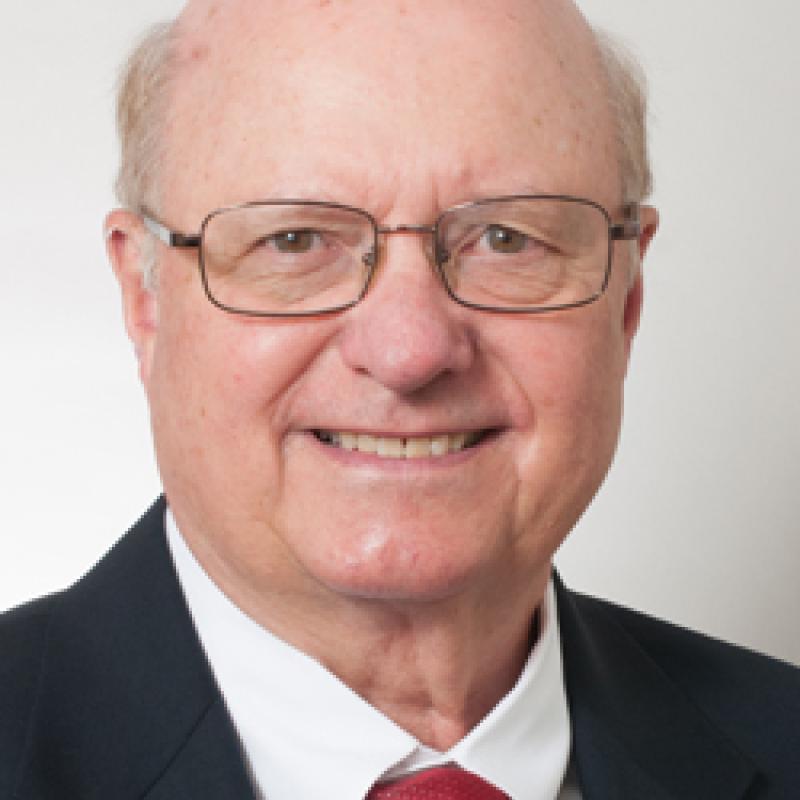
Professor Wyrsch was an Assistant Adjunct Professor in the Busch School of Business, having taught business law courses for many years [1978-2015]. He recently retired from active teaching and he is now a Business Law Faculty Fellow, where he works with students who are interested in attending law school or who have legal questions related to their course work. He also assists the Business School in the development or modifying of its business law course program and coordinates with the Columbus Law School incident to certain joint programs that it has with the Business School. He served as an officer in the U.S. Army (3rd Infantry Division), as a Headquarters and Headquarters Company Commander and a Division Procurement /Supply Officer (1967-1969). Following his graduation from law school he worked as a Senior Attorney for the Office of General Counsel, the Government Accountability Office (GAO) (1972-2001). GAO is the major investigative and program assessment agency for the U.S. Congress. During his early years at GAO he specialized in the areas of government budgeting, accounting, auditing and financial matters. For most of his GAO career Professor Wyrsch concentrated in the areas of national security, intelligence, international affairs, and the defense industry. During these years he (1) provided legal advice and assistance during the course of major GAO investigations of government programs and individuals, (2) drafted numerous legal opinions and decisions, and major legally-intensive portions of GAO published reports, (3) testified before Congress, and (4) drafted proposed federal legislation and segments of official congressional reports.
Professor Wyrsch taught law school courses for many years: as a Professorial Lecturer in Law at the George Washington University Law School [15 years], and as Distinguished Lecturer at the Columbus School of Law, The Catholic University of America, both in adjunct [20 years] and full-time [12 years] capacity. He received many teaching awards and recognitions during his years at that Law School (e.g., “Professor of the Year,” Most Supportive Professor”).In four Law School commencements, the CUA graduating students voted Professor Wyrsch as the Faculty Graduation Marshal, a high honor. He also taught law courses in the American Law Program (15 years), which is a program co-sponsored by the Catholic Law School and the Jagiellonian University (Cracow, Poland).
Professor Wyrsch and his wife Claire live in Silver Spring, Maryland. They have two children: Kara Anderson, who graduated from the University of Maryland Law School, and Michael, a career officer in the U.S. Marine Corp as a fighter jet pilot. Michael has recently retired, his last position being a Commander of a F-35B Squadron. For many years he had served in various leadership, volunteer positions in local government, community service, and youth sports organizations.
Education
- J.D. from Houston Law School
- LLM, Corporation Law from George Washington University
- MBA from George Washington University
Expertise
- Business Organizations
- Commercial Transactions
- Legal Accounting; Auditing and Finance
- Legal Aspects of Government
- Regulation of Business
Languages
- English
Courses Taught
- MGT 321 Commercial Transactions
- MGT 322 Business Organizations and Property Rights
- MGT 371 The Legal and Policy Aspects of Government Regulation of Business
- ACCT 480, 580 The Legal Aspects of Accounting, Auditing and Finance
Publication
For most of his GAO career Prof. Wyrsch concentrated in the areas of national security, intelligence, international affairs, and the defense industry. During these years Prof. Wyrsch (1) drafted numerous legal opinions and decisions, and major legally-intensive portions of GAO published reports, (2) testified before Congress, and (3) drafted proposed federal legislation and segments of official congressional reports.
Notable congressional work:
- the federal organizational framework for combating international terrorism,
- the regulation & prevention of over-concentration within the defense industry,
- the regulation of foreign acquisition of U.S. firms (the Exon-Florio Act),
- the designation and handling of classified information by the executive branch,
- the SEC’s implementation of the Foreign Corrupt Practices Act,
- establishing international safeguards against proliferation of nuclear materials,
- the enactment and enforcement of the Federal Computer Security Act,
- the accountability for Presidential campaign contributions & expenditures
- oversight of confidential expenditure accounts in the executive branch, including the White House.
- federal regulation of the export of militarily-sensitive items by defense firms, and
- the establishment & role of Inspector General Offices in federal agencies.